
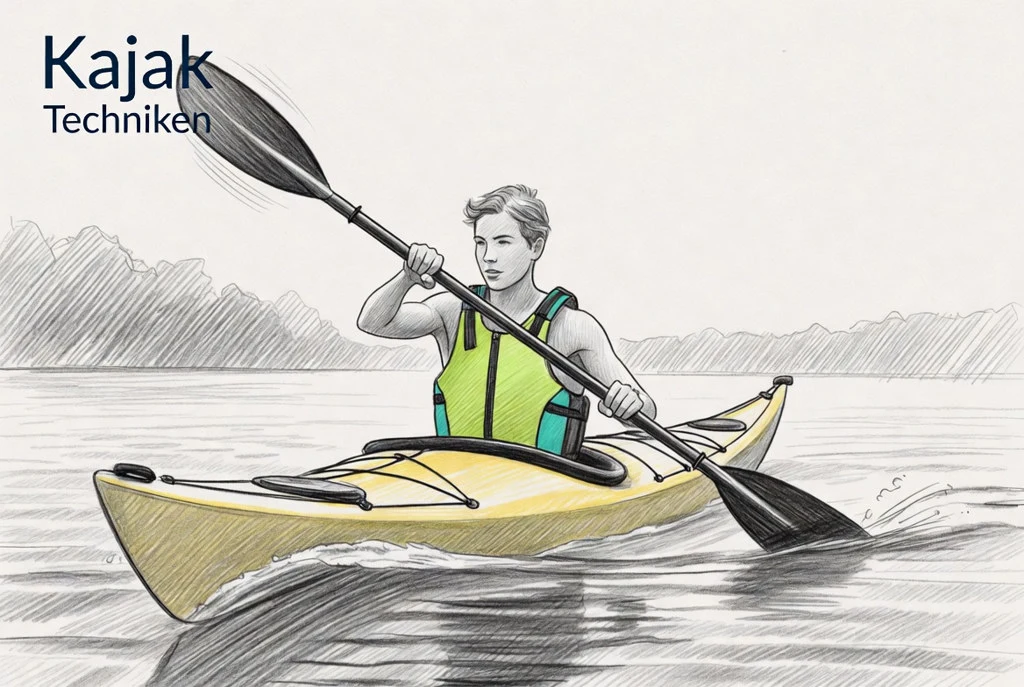
Kayak
Forward stroke
The rhythm for kayaking: catch, power, exit, recovery.
Overview
With a double paddle you alternate rhythmically left and right — the forward stroke is your fundamental movement on any lake. Power comes from torso rotation, not arms alone. An even rhythm keeps you stable and saves energy on longer outings.
Step by step
Catch — set the blade
Lean slightly towards the blade and submerge it fully at the front — not just the tip. Upper body and shoulders are rotated towards the paddle side, lower arm extended. The catch is quiet and clean, without splashing.
Power — torso pulls
The blade holds the water, your torso rotates towards the paddle side. Upper arm pushes, lower arm pulls — together they create the stroke. Power sits in hips and back, not in your hands.
Exit — release
Lift the blade at the hip — not further back or you brake. Exit stays low and close to the boat so you reach the next catch quickly.
Recovery — return
Carry the blade low over the water to the opposite side. Shoulders stay relaxed, the switch is fluid. Even left-right rhythm keeps course and pace stable.
Common mistakes
Arm paddling
Common mistake
Only arms and shoulders work — torso stays rigid. You tire quickly and the kayak wobbles more.
Better
Shoulders and torso rotate with every pull. Arms transfer power, they do not create it.
Blade too deep
Common mistake
The blade goes too deep or too far from the boat side — more resistance, less forward drive.
Better
Horizontal pull at water depth, parallel to the kayak axis. Clean catch, clear exit at the hip.
Safety
Watch for other paddlers, swimmers and boats — especially near shore. If unstable, paddle in shallow water or land. Life jacket as set out in the safety guide; avoid capsizing near the dock.
Read the safety guidePractical tips for the water
Calm water first
Practise the basic stroke on calm water before adding current and headwind. On the water, a calm rhythm matters more than speed.
Learning path
Keep learning
Recommended order in this discipline — from getting started to the next technique.
Frequently asked questions
What rhythm should I use?
What paddle length?
Ready for the water?
Technique in mind — now get on the water safely. Find an Aquadock station near you and book online.
Note: This guide is for general education only and does not replace personal instruction by qualified staff, a lifesaving certificate or a water assessment. It does not establish liability for Aquadock for damage arising from applying the techniques described. Always follow the safety guide, terms and conditions, local regulations and current weather and water conditions. Children only under adult supervision. Paddling at your own risk.