
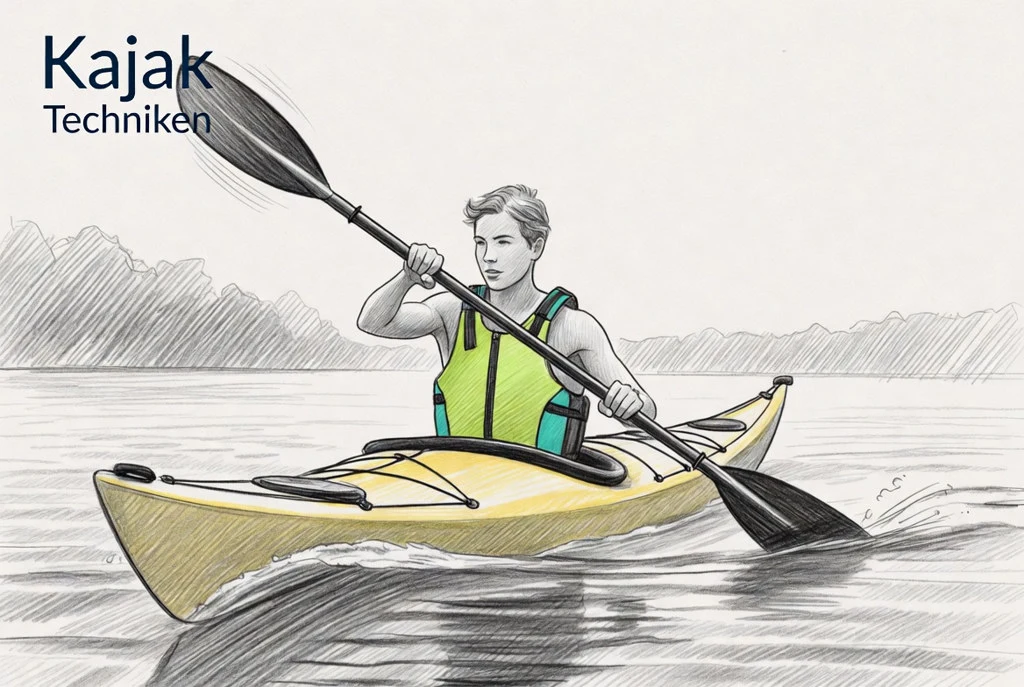
Kayak
Reverse stroke & stop
Control and braking — important when landing.
Overview
Reverse strokes give you room when there is no space ahead or you want to land at the dock. You place the blade behind your hip and pull forwards — the kayak glides backwards. Short stop movements help you brake further.
Step by step
Submerge behind
Turn your upper body towards the paddle side and place the blade in the water behind your hip. Submerge fully, shaft as vertical as possible. Lower arm leads, upper arm stabilises — knees stay in the cockpit.
Pull forwards
Pull the blade in a long arc along the boat side forwards. Power from torso rotation, not just arms. The kayak moves backwards — even strokes instead of single power bursts.
Stop
For quick braking: push the blade flat in front of your body into the water and hold briefly. Then switch back to a normal reverse stroke. At the dock, two to three controlled reverse strokes per side are often enough.
Common mistakes
Blade too deep
Common mistake
The blade goes too deep or far from the boat side — you fight the water instead of using it.
Better
Horizontal pull near the surface, parallel to the kayak. Full arc from behind to the foot line.
Safety
Before going backwards, check space behind and to the side — glance over your shoulder. Work slowly near the dock, do not surprise other paddlers. Use the stop stroke only briefly and in a controlled way, not as a continuous movement.
Read the safety guidePractical tips for the water
Landing at the dock
Start braking early with reverse strokes — not only in the last few metres at the dock. Short sequences left and right keep the kayak straight.
Learning path
Keep learning
Recommended order in this discipline — from getting started to the next technique.
Frequently asked questions
When to paddle backwards?
Ready for the water?
Technique in mind — now get on the water safely. Find an Aquadock station near you and book online.
Note: This guide is for general education only and does not replace personal instruction by qualified staff, a lifesaving certificate or a water assessment. It does not establish liability for Aquadock for damage arising from applying the techniques described. Always follow the safety guide, terms and conditions, local regulations and current weather and water conditions. Children only under adult supervision. Paddling at your own risk.