
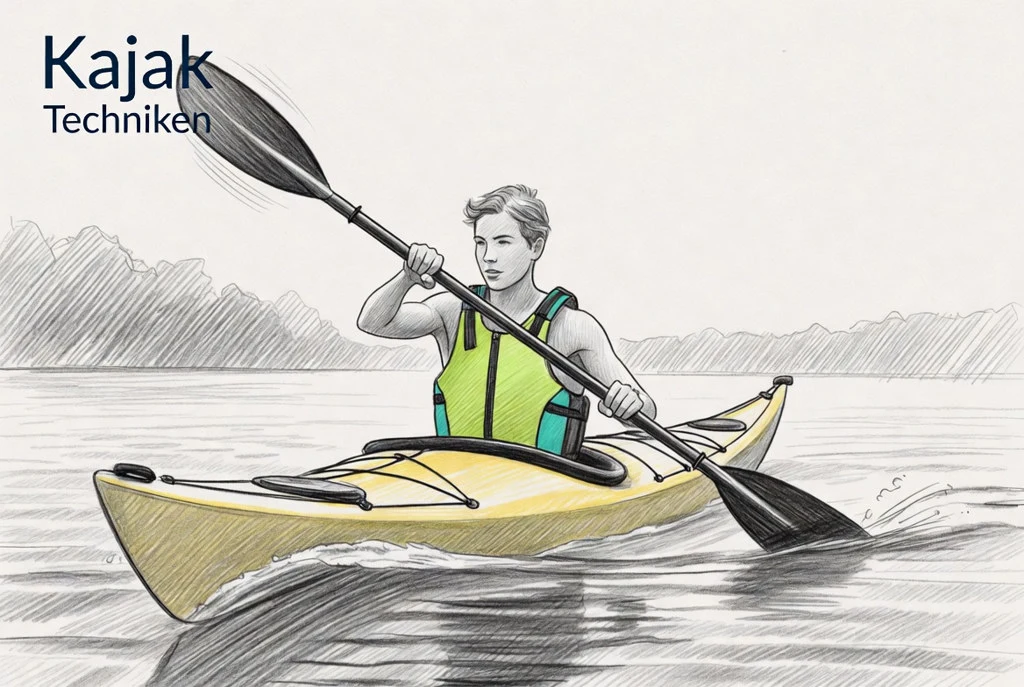
Kayak
Seat & basic posture
The foundation for every kayak stroke — comfortable and powerful.
Overview
Good seated posture connects you firmly to the boat without tensing up. You transfer power from your torso, sit comfortably for longer and react faster to waves or wind. Adjust everything on shore — not on the water.
Step by step
Sit upright
Sit in the seat with an upright pelvis — a slight forward tilt from the hips, not from the lower back. Back stays neutral, chest open. This lets you rotate sideways without tipping.
Feet & knees
Set the footrest so knees are slightly bent and feet rest firmly. Knees press lightly outward against the thigh braces — this gives lateral support and helps with edging later.
Paddle grip
Hands shoulder-width on the shaft, elbows roughly 90° when you hold the paddle above your head. Grip is symmetrical — both hands equally far from the centre. A grip too narrow makes rotation harder.
Eyes & relaxation
Look at the horizon and your planned route — not at the boat. Shoulders relaxed, breath calm. Light tension in the torso is enough; cramped arms tire quickly.
Common mistakes
Slouching
Common mistake
Rounded lower back, collapsed chest — poor power transfer and back pain quickly.
Better
Neutral back, light activation in the torso. Pelvis upright, as if sitting on the front edge of a chair.
Safety
Adjust seat, footrest and backrest before launching — on shore or at the dock, never in a moving kayak. Life jacket on, check body contact with the boat. If your feet go numb: land briefly and readjust.
Read the safety guidePractical tips for the water
Adjusting a rental kayak
On an Aquadock kayak, the footrest adjusts without tools. On your first booking, on-site support can help — take two minutes on shore before you slide into the water.
Learning path
Keep learning
Recommended order in this discipline — from getting started to the next technique.
Frequently asked questions
Adjust the backrest?
Ready for the water?
Technique in mind — now get on the water safely. Find an Aquadock station near you and book online.
Note: This guide is for general education only and does not replace personal instruction by qualified staff, a lifesaving certificate or a water assessment. It does not establish liability for Aquadock for damage arising from applying the techniques described. Always follow the safety guide, terms and conditions, local regulations and current weather and water conditions. Children only under adult supervision. Paddling at your own risk.